Agentic Community as Service: AGI Adoption Needs Reuse, Not More Tutorials
The platform logic that fits the agent era: people express intent, agents execute, the platform carries the intent. Everything in between should be absorbed by the agent and the platform, not handed back to the user.
Chinese version: Agentic Community as Service:AGI 普及需要的不是教程,而是可便捷复制的资产
Most community platforms are good at spreading knowledge. They are bad at delivering outcomes.
Discord, WeChat groups, forums, Xiaohongshu, X — they all let people talk about agents, show off cases, and trade hard-won insight. Guides, group chats, forum threads, tutorial videos: great for spreading experience, useless for shipping a result. None of them can take a non-technical person who just saw something work and let them bring that same result home, into their own life, right now.
What ordinary people want has never been “to learn agents.”
What they want is simpler: the thing that annoys me every single day — can it just stop being my job?
So here is the claim:
The agent era doesn’t need more places to talk about agents. It needs a platform that reliably delivers results.
- For the user, it’s first a place to discover a need and copy a result.
- For agent capability itself, it’s the machinery that turns a one-off case into a reusable asset.
Its job isn’t to help more people understand agents. Its job is to let more people enjoy what agents produce without ever having to understand them.
I call this Agentic Community as Service.
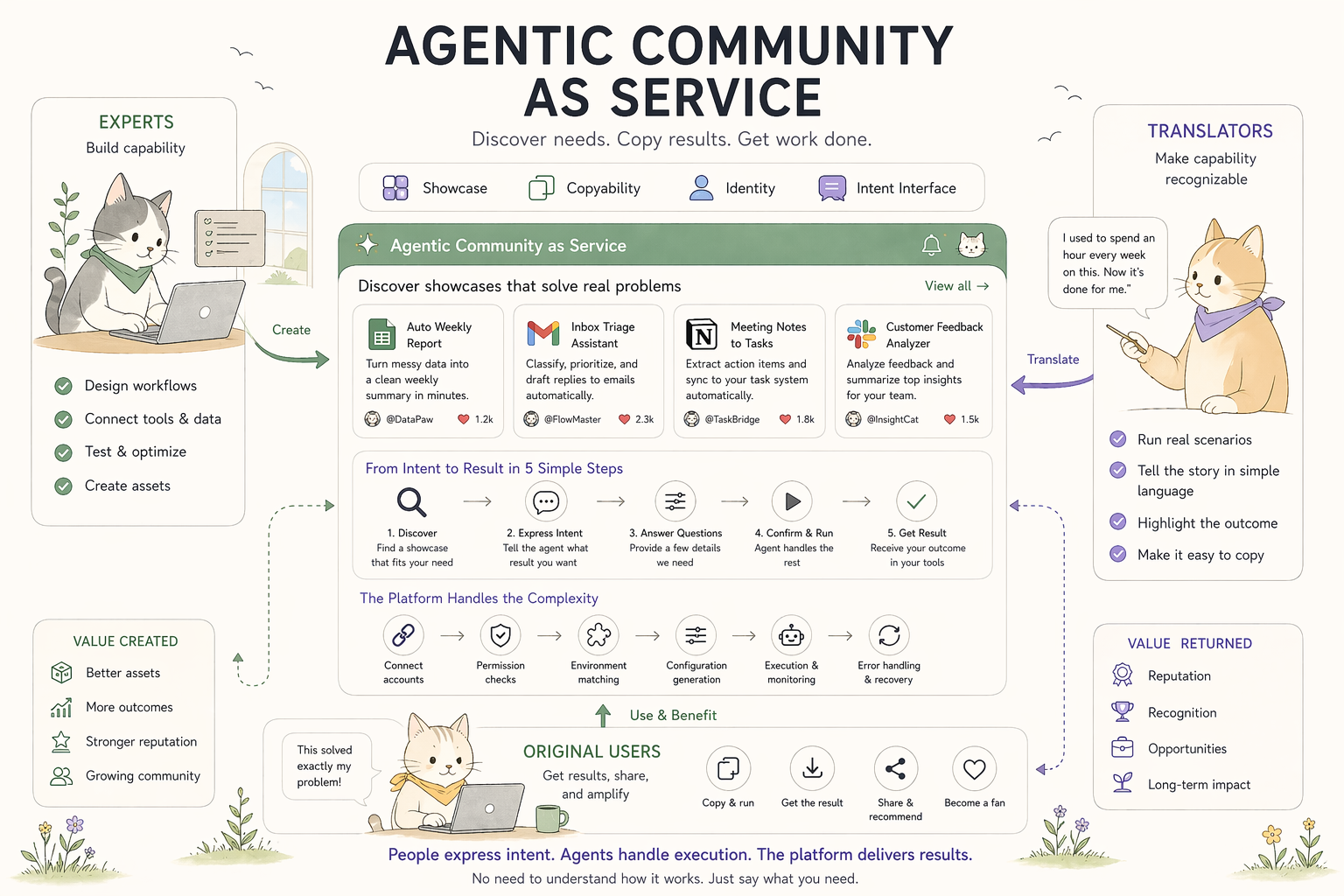
Caption: Experts produce capability. Translators turn capability into scenarios. Original Users show up with real needs. The four layers in the middle do the actual work — turning intent into results people can copy.
Why today’s platforms fall short
A platform that’s actually alive has at least three things moving through it at once:
- Content — knowledge, experience, opinions, usage notes
- Assets — templates, workflows, agents, scripts, outputs you can reuse as-is
- Social capital — identity, status, recognition, belonging, the web of relationships
With only content, you get a feed, or a forum. Things scroll past, people read and forget, almost nothing compounds.
With only assets, you get a tool marketplace. People show up, transact, and leave. No shared belief, no collective momentum.
With only social capital, you get a scene. Lots of people, lots of warmth, almost no production or reuse.
A real platform needs all three at once, each one feeding the others — and in the agent era it has to push assets toward the center. Because what people need most is no longer “knowing how someone else did it.” It’s reusing the result someone else already got working.
That’s exactly where the current platforms break down.
On Discord, WeChat, a forum, or Xiaohongshu, a great case shows up as a post, a chat log, a screenshot, a tutorial video. It can spark desire. It can inspire. It can even get a few skilled people to rebuild it themselves. But for almost everyone else, there’s a long stretch of friction between seeing the case and getting the same result — friction the platform never absorbed:
- working out whether the scenario even applies to you
- figuring out which model and tools were used
- recreating the environment and dependencies
- wiring up accounts, data sources, permissions
- debugging everything that breaks along the way
This isn’t just “a high barrier.” It’s that these platforms were never built to deliver an outcome in the first place.
They’re built to spread understanding. They were never built to spread capability.
The old logic: people operate the platform, and the platform carries content.
The logic the agent era wants: people express intent, agents do the execution, and the platform carries the intent.
What the user actually has to do should collapse to almost nothing:
- find a showcase that maps to their situation
- say “I want that result too”
- answer a few necessary questions
- confirm
- get the result
Everything else should be swallowed by the agent and the platform — not handed back to the user.
If a platform still expects an ordinary person to reason about toolchains, connectors, permissions, and workflow orchestration like a developer before they can enjoy a result, it isn’t mass infrastructure for the agent era yet.
The base model companies have already started down this road — adding connectors, extensions, skills. They’re all pushing the model out of “pure chat” and toward something connectable and executable, something that can reach into outside systems. The connectors, integrations, and skills surfaces in OpenAI, Codex, and Anthropic’s Claude Desktop are all clear signals.
The edge of the platform is set by Translators
An agent platform doesn’t have two kinds of people. It has three:
- Experts — the people who produce capability
- Translators — the people who turn capability into scenarios
- Original Users — the people who vote with their needs, their copies, their shares
The most important one, and the most underrated, is the Translator.
Experts make the system stronger. They get the workflow running. They produce the hard capability. But Experts naturally drift toward density, jargon, and altitude. They talk about routing, context, tool calls, permission boundaries, deployment. All of it matters. None of it belongs at the front door.
Original Users don’t care how you pulled it off. They care about:
- Is this my problem too?
- Can I just use this result directly?
- How much learning and setup is this going to cost me?
That’s where the Translator earns their keep.
They don’t have to understand the plumbing. They run one real scenario end to end, then translate the Experts’ complex capability into language a normal person recognizes themselves in:
- “I used to spend an hour a week pulling together client updates. Now it just happens.”
- “I used to dig through chat logs to write my weekly report. Now it’s waiting for me before I leave.”
- “I don’t understand automation, but I finally stopped backfilling these spreadsheets by hand.”
Notion didn’t break out because of the people building the most elaborate databases. It broke out because of the people who retold a complex product as slices of ordinary life. Figma Community didn’t spread only because designers shared their work — it spread because everyone else could grab it and change it. Canva templates went mainstream not because ordinary people suddenly learned design, but because the platform packaged expertise into something low-friction you could just drop in.
The edge of a platform isn’t set by its Experts. It’s set by its Translators.
Experts set the ceiling of what’s possible. Translators decide whether that capability ever escapes the technical circle and becomes something the rest of the world can recognize, share, and copy.
What Agentic Community as Service provides
Four things, layered:
- Showcase — the smallest unit that travels
- Copyability — the minimum delivery promise
- Identity — a reputation system for contributors
- Intent Interface — the user states a need and carries none of the setup
Start with Showcase.
The unit that should circulate in the agent era isn’t the post, the tutorial, or the prompt. It’s the showcase. A good one answers at least four questions: who I am, where I was stuck, what the agent actually did for me, and how you reproduce it. The first three earn recognition. The fourth decides whether it’s just content or an actual asset.
Then Copyability.
A showcase you can only read, like, bookmark, and reshare is still just content. A showcase that copies reliably, with a high enough success rate to actually cash out “I want that result too” — that’s an asset. It’s the whole reason Notion templates, Figma Community files, and Canva templates travel so well. Their value isn’t how good they look. It’s that the moment you copy one, you can use it.
If a platform can’t turn showcases into assets that copy and actually work, it never becomes a service. It just becomes one more place to admire what other people built.
Then Identity.
If Experts and Translators only ever contribute once, with nothing they can accumulate, carry, or be seen for, the platform decays back into disposable content fast. Whoever produces the widely-copied assets, whoever translates the hard stuff for everyone else, whoever helps the most people actually reproduce a result — they should be the ones building up reputation, relationships, and opportunity. No identity layer, no long-term supply.
Finally, Intent Interface.
An ordinary user should never be forced to understand the substrate. They should only have to say, clearly, what their problem and goal are — “I’m drowning in WeChat messages every day,” “I want sales follow-ups summarized automatically,” “I want meeting notes pushed into my task system.” The platform catches the intent. Environment matching, config generation, account connection, permission checks, execution — the agent should take all of it.
Put the four together and you have Agentic Community as Service.
It isn’t an “agent content community.” It’s a platform that hears the real need, translates the hard capability, packages the result into something you can copy, and turns contribution into reputation and opportunity.
Which is exactly why today’s connectors, integrations, and desktop plugins aren’t enough on their own. They answer “what can the model connect to?” They don’t yet answer “why would an ordinary person use it, how do they find it, how do they copy it, and how does the contributor get rewarded?”
The industry is busy building the kitchen. It hasn’t gotten around to the menu, the ordering system, the front of house, or the reason anyone comes back. That empty space is the Agentic Community as Service platform.
Some of Codex’s current surfaces already make the direction easier to see. The plugins page wraps external tools and workflows into capabilities you can browse and add. The automations page hints at something further out: recurring human intent that can be saved, scheduled, and reused instead of re-explained every time.
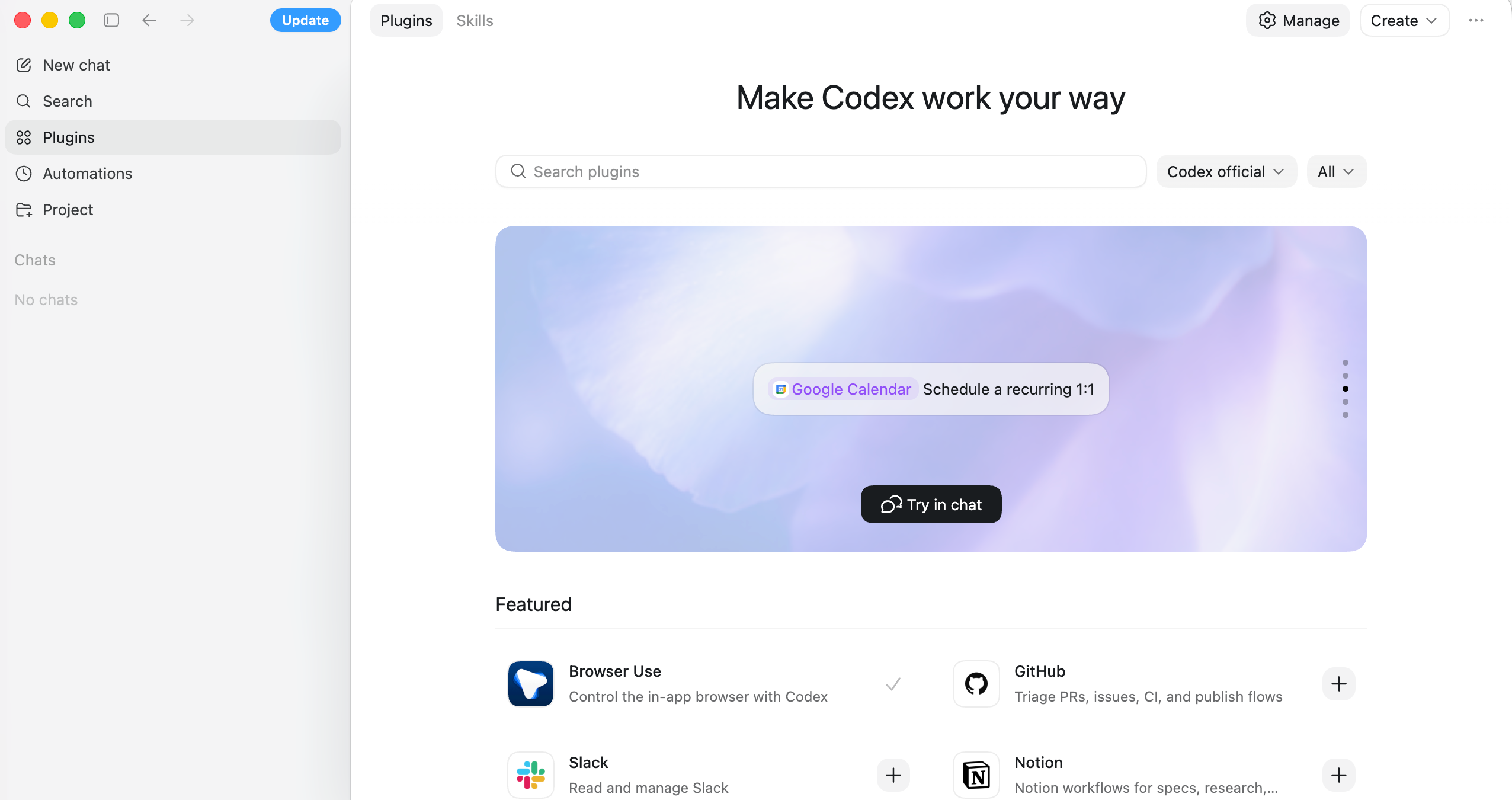
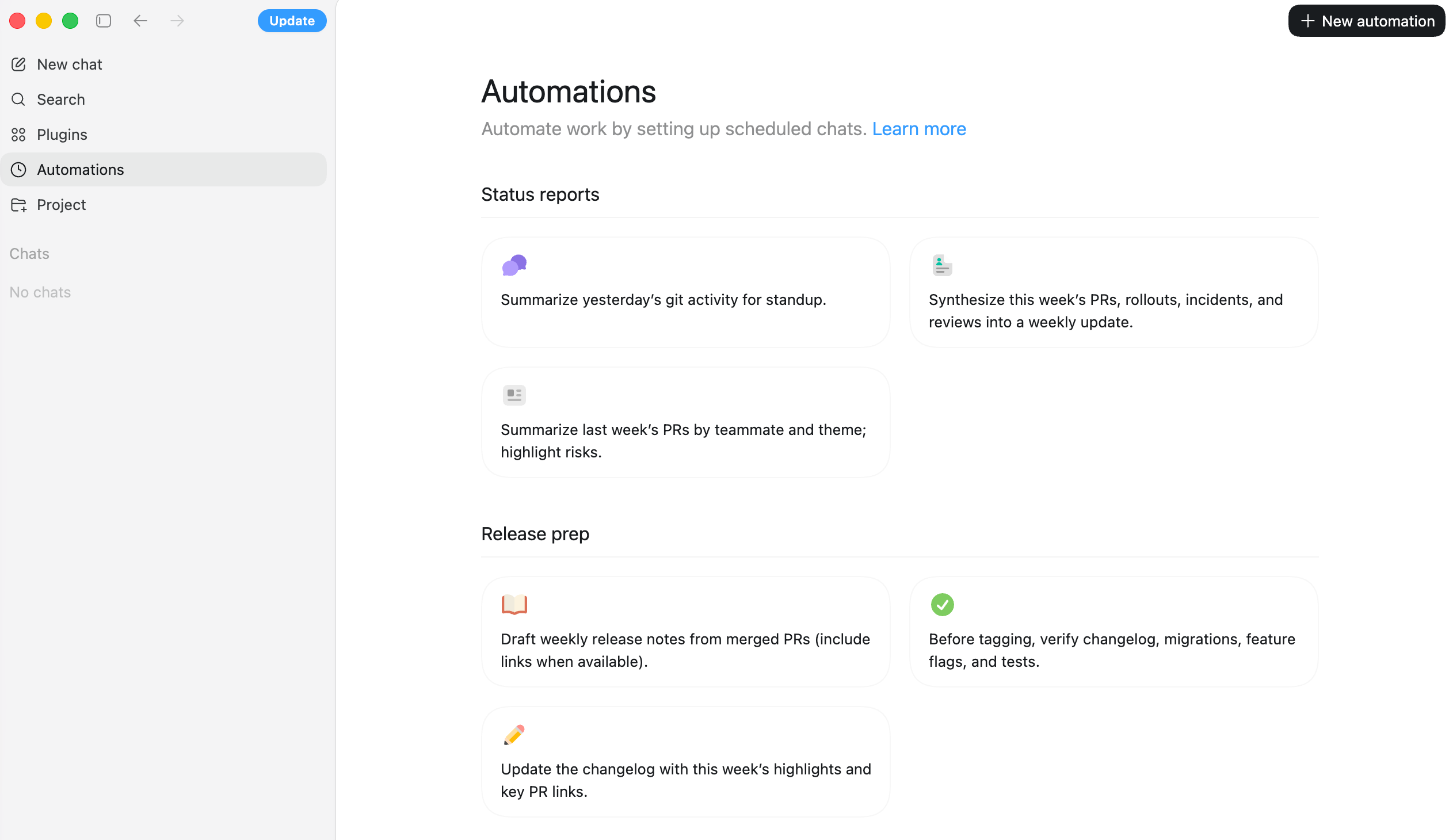
Caption: The plugins and automations pages already hint at a new way to distribute capability — external tools and workflows stop being config buried inside a tutorial and start becoming things a user can browse and add. Looking back in early June at this April build, the experience has already gotten noticeably smoother.
So who ends up filling that spot? Which model company ends up owning the agent era’s X or YouTube — or does it turn out to be someone who doesn’t build models at all, and just runs the service platform on top? I genuinely want to know the answer.
Either way: the real sign that AGI has arrived for everyone isn’t that everybody writes prompts, or learns agentic workflows, or joins a technical community.
It shows up in a new kind of platform — one that:
- holds real needs
- accumulates results you can copy
- rewards the translators and the builders
- lets ordinary people enjoy what complex systems produce without ever having to understand them
Agentic Community as Service is All You Need. </content> </invoke>